
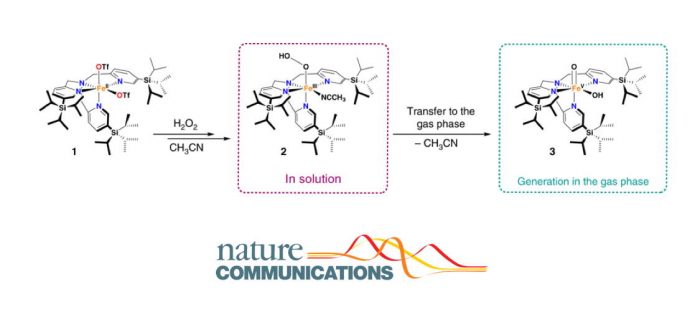
Terminal oxo complexes of late transition metals are frequently proposed reactive intermediates. However, they are scarcely known beyond Group?8. Using mass spectrometry, we prepared and characterized two such complexes: [(N4Py)CoIII(O)]+ (1) and [(N4Py)CoIV(O)]2+ (2). Infrared photodissociation spectroscopy revealed that the Co?O bond in 1 is rather strong, in accordance with its lack of chemical reactivity. On the contrary, 2 has a

Institut de Química Computacional i Catàlisi
- sec.iqcc@udg.edu
- +34 972 41 83 57
Category: Portada
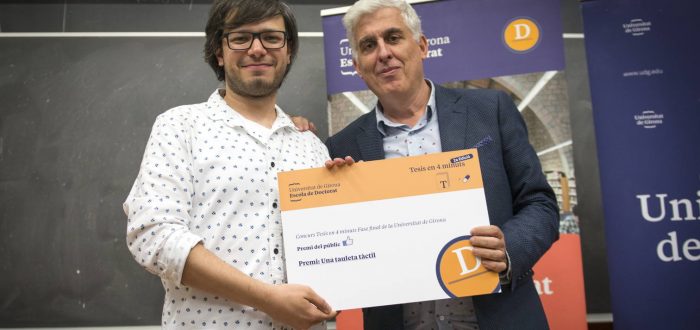
Steven Roldán, a PhD researcher of the Institute of Computational Chemistry and Catalysis (IQCC) working in the QBIS-CAT group won today the public prize of the contest “Your thesis in 4 minutes” held at the University of Girona. It was the video with more likes. The PhD thesis of Steven, supervised by Dr. Josep M. Luís
The Catalan Institution for Research and Advanced Studies (ICREA) is a foundation promoted by Catalan Government whose aim is to encourage research in Catalonia. Miquel Costas, a researcher member of IQCC and ERC-Starting Grant holder won the ICREA Acadèmia awards 2018 for his research carrier. It is the third time that he receives this award (after
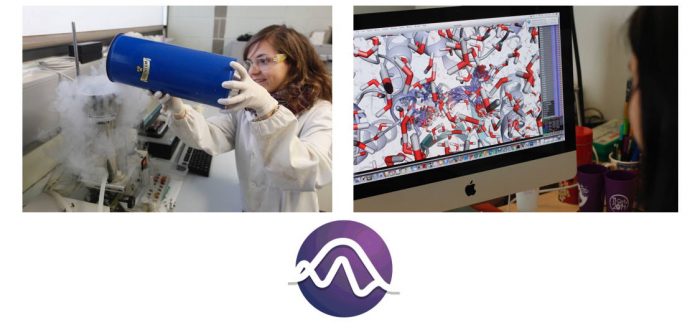
The Institute of Computational Chemistry and Catalysis (IQCC) of the University of Girona (UdG) is a worldwide reference unit in computational chemistry and catalysis that aims at carrying out groundbreaking research on predictive chemistry for catalysis, with special focus on the processes occurring at the confined space for the coming years. One of the pillars
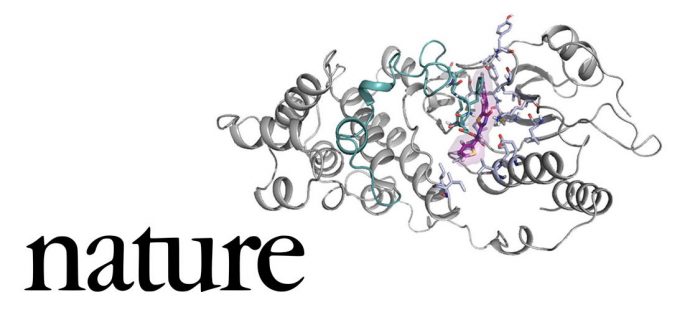
A few months after the discovery how an enzyme stores the energy in our body, researchers of the IQCC have published again a paper in Nature. Ferran Feixas and Sílvia Osuna provided the computational chemistry support for the discovery that a protein related to cell stress (p38g) regulates cell division. The activation of this protein is essential
A group of chemists from the Euskal Herriko Unibertsitatea (UPV/EHU) and the Donostia International Physics Center (DIPC) lead by Dr. Eduard Matito (ex-member IQCC) together with the IQCC members Mauricio Rodríguez-Mayorga (now in ETH Zurich, Switzerland) and Dr. Miquel Solà, have studied the Coulomb hole of Ne from highly-accurate CISD wave functions obtained from optimized even-tempered basis sets.
The constant environmental pollution due to different toxic products derived from oil-based industries is nowadays a worldwide problem. Specifically, the toxic products of anthropic origin are not always possible to contain, which makes it necessary to intervene in its decontamination. This challenge can be achieved by breaking down the toxic products using specific bacteria that
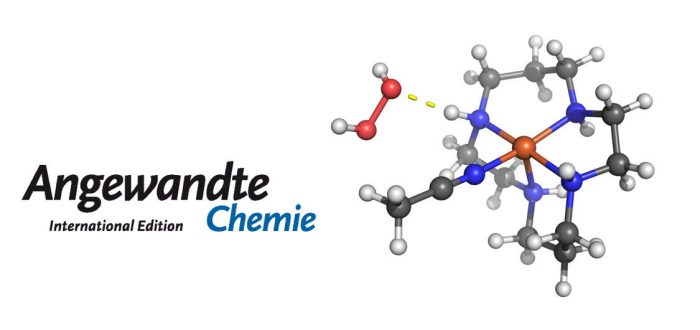
Oxoiron(IV) species are the active oxidants in catalytic oxidation reactions by nonheme iron enzymes, but have been rarely captured and/or identified as the actual oxidizing species in catalytic epoxidation or hydroxylation reactions involving synthetic nonheme iron complexes. We now report the generation of a nonheme oxoiron(IV) intermediate, [(cyclam)FeIV(O)(CH3CN)]2+ (2; cyclam = 1,4,8,11-tetraazacyclotetradecane), in the reactions
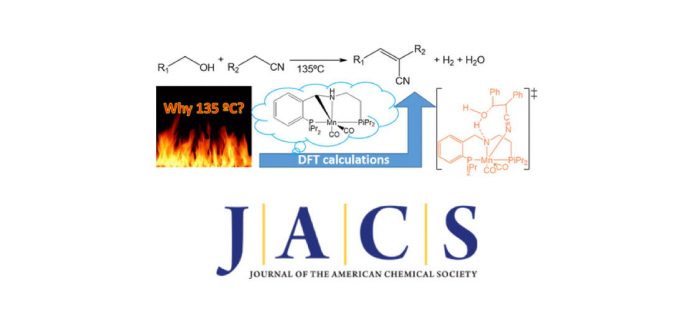
A pure computational paper by Miquel Solà, Albert Poater and co-workers has been undertaken to favour the generation of H2, once known experimentally by Milstein and coworkers that Mn-pincer could catalyze the acceptorless dehydrogenative coupling of nitriles and alcohols to yield acrylonitriles. The reaction mechanism proposed in that work contained some intermediates that, in most

After some recent papers in Nature, and Nature by members of the IQCC, and in Nature and Science by former IQCC members, right now we have a new entry: Today a former IQCC member (Davide Angelone) published in Science, with the publication of “Organic synthesis in a modular robotic system driven by a chemical programming language”. Davide defended his