
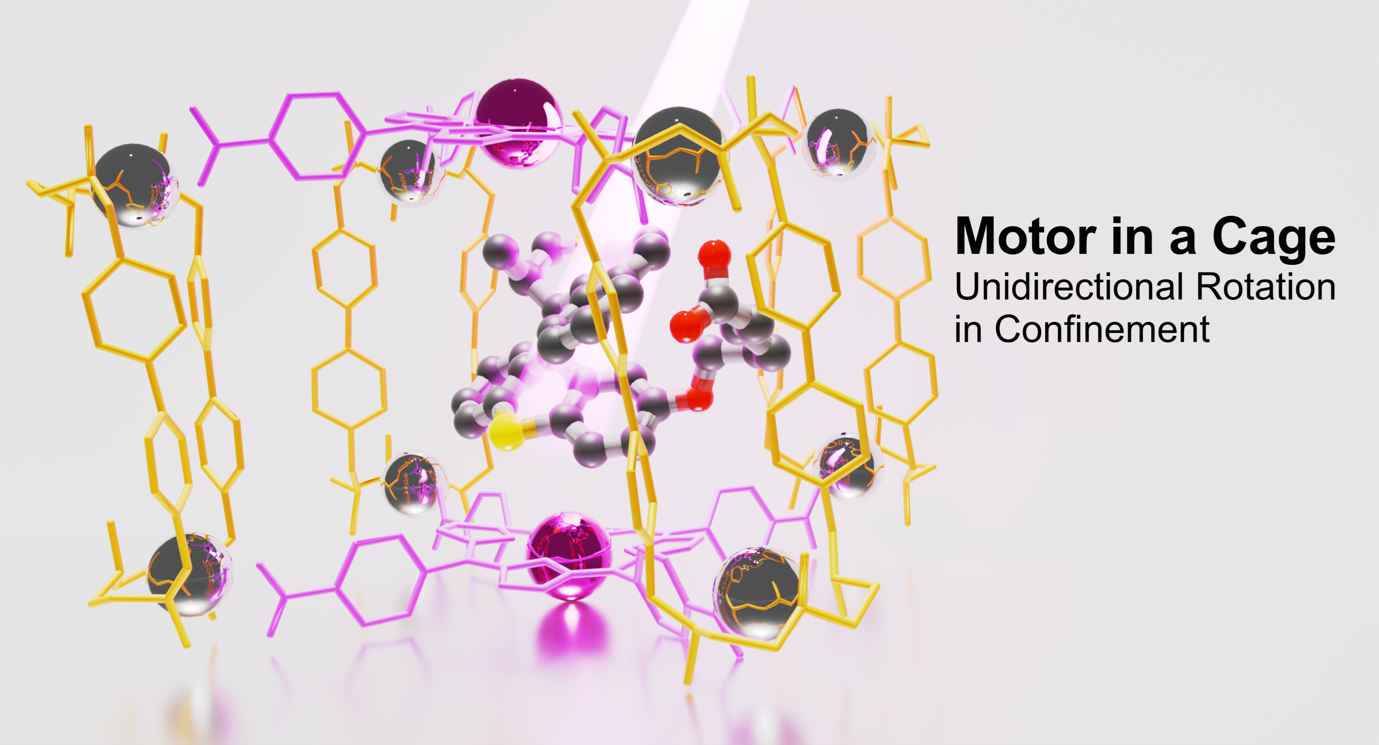
The IQCC group, led by Prof. Xavi Ribas, in collaboration with Nobel laureate Prof. Ben Feringa (Univ. Groningen), has reported a breakthrough study on the encapsulation of a unidirectional molecular motor within a supramolecular nanocage. The work, published in J. Am. Chem. Soc. (https://doi.org/10.1021/jacs.5c16349) in January 2026, demonstrates that the motor can undergo rotation while confined within a metal–organic cage. By exploiting hydrogen-bonding interactions between the guest’s alkyl–COOH tail and the carbonyl residues lining the cavity, the motor completes a full 360° unidirectional rotation cycle without leaving the host and without noticeable alteration of its rotational properties.
This strategy provides an attractive proof-of-concept that can be extended to other molecular motors through simple functionalization with an alkyl–COOH chain, enabling their accommodation within nanocages without strict size-fit constraints. Based on these design principles, next-generation motor–cage host–guest systems could be developed, including cages that facilitate energy transfer, multiple motor anchoring points, or motors and cages of varied sizes. Understanding these confined rotational phenomena may ultimately inspire the design of synthetic systems with unique mechanical functions, analogous to nature’s DNA-packing motors.
C. Fuertes-Espinosa, M. Ovalle, Y. Gisbert, C. Sabrià, V. Iannace, J. M. Luis, F. Feixas, A. Ryabchun, X. Ribas and B. L. Feringa
“Light-Induced Rotation of a Molecular Motor in the Confined Space of a Metal–Organic Nanocage”
J. Am. Chem. Soc. 2026, ASAP
DOI: 10.1021/jacs.5c16349
Girona, January 29th 2026
For more info: ges.iqcc@udg.edu