Dr. Marc Garcia-Borràs has been selected as Beatriu de Pinós researcher of the Institute of Computational Chemistry and Catalysis (IQCC) working in the CompBioLab group of Prof. Sílvia Osuna. Dr. Garcia-Borràs did his PhD in 2015 at the University of Girona under the supervision of Prof. Miquel Solà and Dr. Josep M. Luis. During his doctoral studies

Institut de Química Computacional i Catàlisi
- sec.iqcc@udg.edu
- +34 972 41 83 57
Category: Portada
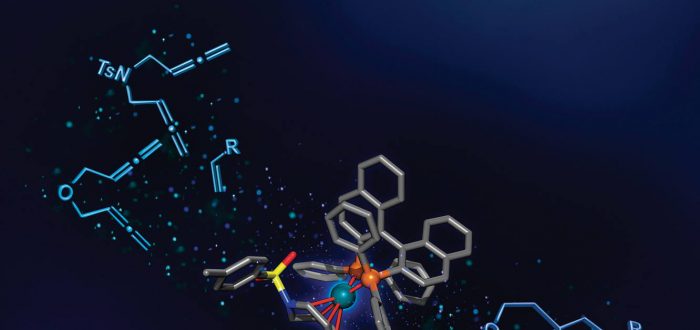
A novel methodology to transform bisallenes into a variety of polycyclic derivatives employing rhodium(I) catalysis has been developed. This transformation encompasses an intramolecular Rh-catalyzed cycloisomerization of bisallenes 1 to deliver a reactive cycloheptadiene, which concomitantly undergoes a regioselective [4 + 2] cycloaddition with alkenes. A complete mechanistic study of this transformation has been undertaken including
Former member Verònica Postils has been awarded best paper 2018 in Computational Chemistry prize given by the Computational Chemistry Group (GEQC) of the Spanish Royal Society of Chemistry (Real Sociedad Española de Química, RSEQ). She has received the award for her paper “An Objective Alternative to IUPAC’s Approach to Assign Oxidation States”. Verònica Postils, Carlos Delgado-Alonso,
On the opening ceremony of the 62nd Annual Meeting of the Polish Chemical Society, organized on 2–6 September 2019, in Warsaw, IQCC researcher Miquel Solà was distinguished as Honorary Member of the Polish Chemical Society “for his outstanding scientific achievements and services for the Society“. The distinction has been delivered to Prof. Solà by Prof. Jerzy B?a?ejowski,
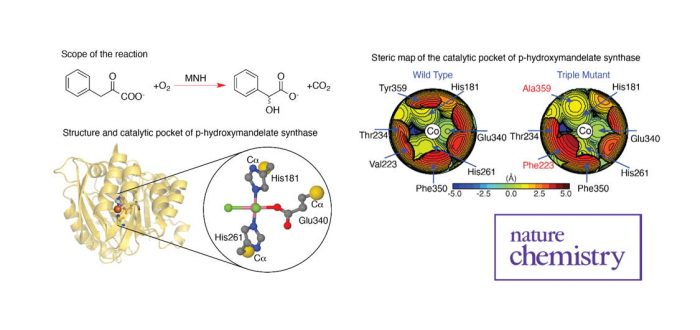
Making chemical reactions faster or more selective can be achieved by catalysts, which can be biomolecular enzymes or transition-metal molecules. Engineering these catalysts to provide specific functionality on demand has been a long-term dream by many chemists. In a recent contribution by a team of researchers from Girona, Italy and Saudi Arabia, this dream has
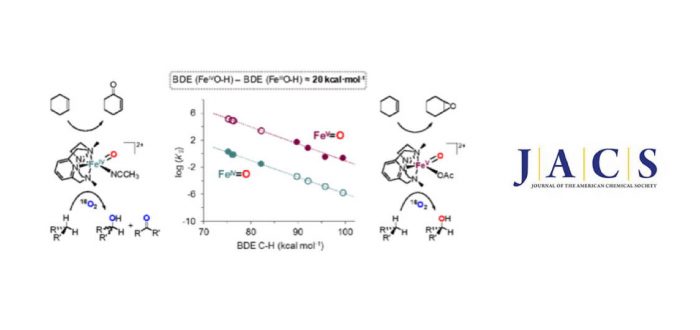
This work directly compares the spectroscopic and reactivity properties of an oxoiron(IV) and an oxoiron(V) complex that are supported by the same neutral tetradentate N-based PyNMe3 ligand. A complete spectroscopic characterization of the oxoiron(IV) species (2) reveals that this compound exists as a mixture of two isomers. The reactivity of the thermodynamically more stable oxoiron(IV)
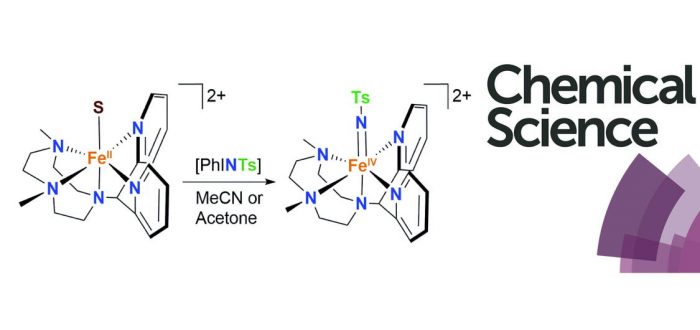
High valent iron species are very reactive molecules involved in oxidation reactions of relevance to biology and chemical synthesis. Herein we describe iron(IV)–tosylimido complexes [FeIV(NTs)(MePy2tacn)](OTf)2 (1(IV) NTs) and [FeIV(NTs)(Me2(CHPy2)tacn)](OTf)2 (2(IV) NTs), (MePy2tacn = N-methyl-N,N-bis(2-picolyl)-1,4,7-triazacyclononane, and Me2(CHPy2)tacn = 1-(di(2-pyridyl)methyl)-4,7-dimethyl-1,4,7-triazacyclononane, Ts = Tosyl). 1(IV) NTs and 2(IV) NTs are rare examples of octahedral iron(IV)–imido complexes and are isoelectronic analogues of the recently described iron(IV)–oxo
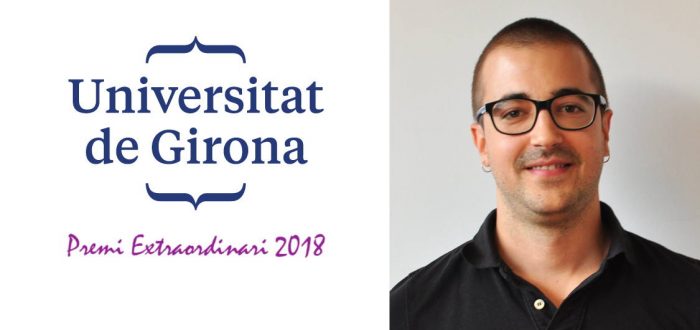
Yesterday, our former member of IQCC Oriol Planas was awarded the Premi Extraordinari for the best PhD thesis in 2018 from the University of Girona. Last year, he defended with success his PhD thesis on “Cobalt-catalyzed C-H functionalization”, supervised by Xavi Ribas and Anna Company. Now, Oriol is continuing his research as a postdoc in the group of Prof. Josep
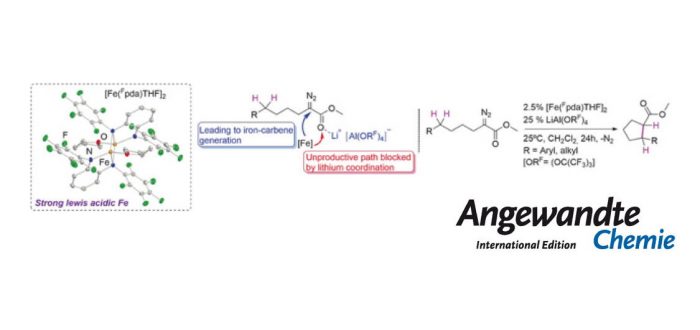
Combining an electrophilic iron complex [Fe(Fpda)(THF)]2 (3) [Fpda=N,N’-bis(pentafluorophenyl)-o-phenylenediamide] with the pre-activation of a-alkyl-substituted a-diazoesters reagents by LiAl(ORF)4 [ORF=(OC(CF3)3] provides unprecedented access to selective iron-catalyzed intramolecular functionalization of strong alkyl C(sp3)-H bonds. Reactions occur at 25°C via a-alkyl-metallocarbene intermediates, and with activity/selectivity levels similar to those of rhodium carboxylate catalysts. Mechanistic investigations reveal a crucial role of the
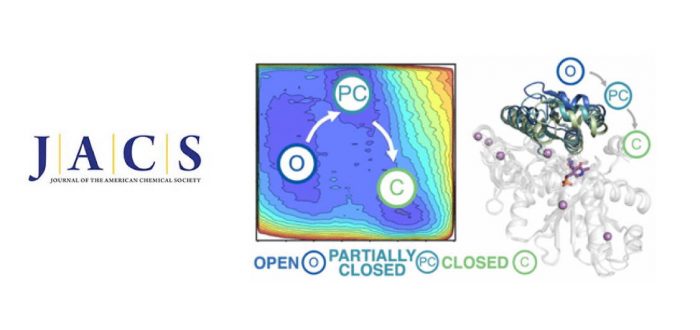
Multimeric enzyme complexes are ubiquitous in nature and catalyze a broad range of useful biological transformations. They are often characterized by a tight allosteric coupling between subunits, making them highly inefficient when isolated. A good example is Tryptophan synthase (TrpS), an allosteric heterodimeric enzyme in the form of an abba complex that catalyzes the biosynthesis of