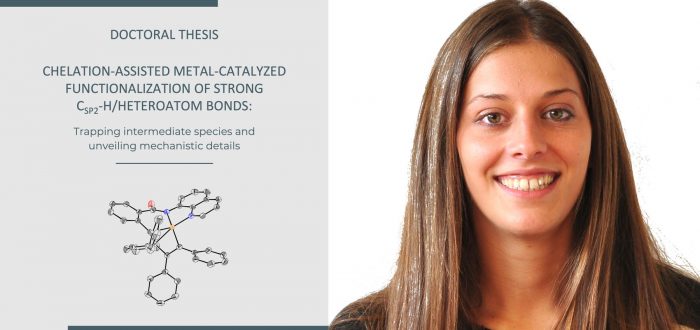
Next Friday will be the defense of the doctoral thesis of Lorena Capdevila Güell, titled “Chelation-assisted metal-catalyzed functionalization of strong: Csp2-H/Heteroatom bonds: Trapping intermediate species and unveiling mechanistic details”, supervised by Xavi Ribas from IQCC. Place: Aula Magna – Facultat de Ciències Date: July 22, 2022 Time: 10.30h We wish her good luck and all the best!

Institut de Química Computacional i Catàlisi
- sec.iqcc@udg.edu
- +34 972 41 83 57
Category: Portada
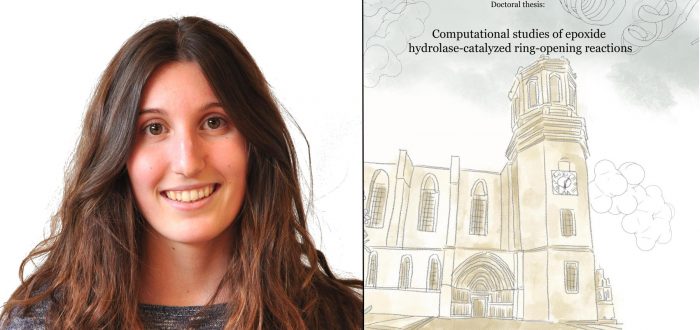
Next Wednesday will be the defense of the doctoral thesis of Eila Serrano-Hervás, titled “Computational studies of epoxide hydrolase-catalyzed ring-opening reactions”, supervised by Sílvia Osuna and Marc Garcia-Borras from IQCC. Place: Sala de Graus – Facultat de Dret Date: July 20, 2022 Time: 16.30h We wish her good luck and all the best! Girona, July 13, 2022 For
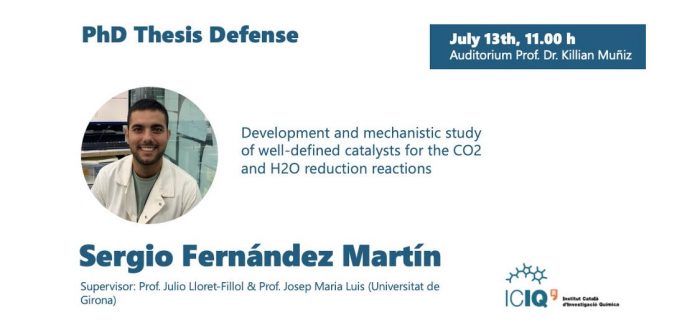
This Wednesday will be the defense of the doctoral thesis of Sergio Fernández Martín, titled “Development and mechanistic study of well-defined catalysts for the CO2 and H2O reduction reactions”, supervised by Josep Maria Luis from IQCC and Julio Lloret from ICIQ. Place: Auditorioum Prof. Dr. Killian Muñiz (Tarragona) and virtual Date: July 13, 2022 Time: 11h

A large number of 2D/2D and 3D/3D aromatic fusions that keep their aromaticity in the fused compounds have been synthesized. In addition, we have previously proven the electronic relationship between the 3D aromaticity of boron hydrides and the 2D aromaticity of PAHs. Here we report the possible existence of 3D/2D aromatic fusions that retain the
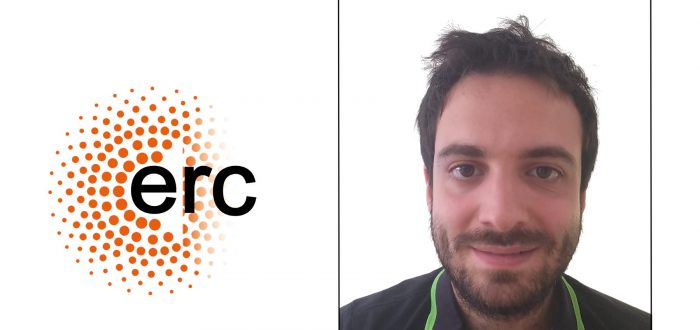
Dr. Galeotti has recently become a new member of the Institute of Computational Chemistry and Catalysis (IQCC) as a postdoc. Dr. Galeotti received his PhD in Chemistry from University of Rome “Tor Vergata” (Italy) in 2022. During his PhD, he worked with Prof. Massimo Bietti and Prof. Michela Salamone on factors governing reactivity and selectivity
This week at the XXXVIII Bienal RSEQ conference in Granada, three IQCC PhD students won awards for the best poster in different symposia. • Ernest Ubasart, PhD student under the supervision of Dr. Xavi Ribas, presented his work on Large Tetragonal Prismatic Supramolecular Nanocapsules as Multi-Functional Platforms, and won one of the best poster awards in
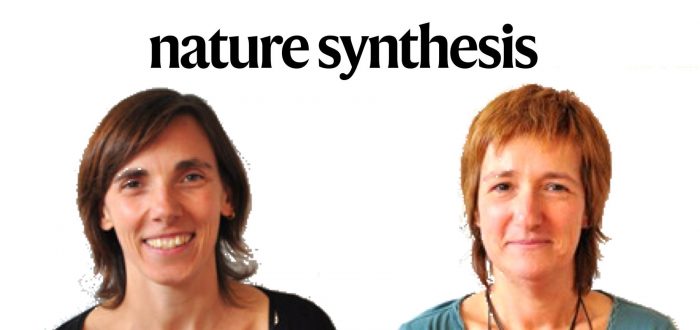
Anna Rogans and Anna Pla-Quintana were invited recently to write a highlight in the News & Views section of Nature Synthesis to describe the significance of Rh-catalyzed cycloaddition reactions, as reported by Uchiyama, Tanaka and co-workers in their paper in Nature Synthesis. Dr. Roglans and Dr. Pla-Quintana take advantage of their expertise in transition-metal catalysed [2+2+2] cycloaddition reactions

Yesterday, the Real Sociedad Española de Química (RSEQ) and Lilly announced that Laia Vicens i Serra, PhD Student in the QBIS-CAT research group at the Institute of Computational Chemistry and Catalysis (IQCC) received one of the three 2022 RSEQ-Lilly awards for best PhD studies in orgànic, pharmaceutical and analytiscal chemistry (XX Premios de Investigación para
Today the European Chemical Society announced that Prof. Sílvia Osuna has been granted the EuChemS Lecture Award 2021. This honour is awarded annually to a junior scientist working in chemistry in one of the countries with a EuChemS member organization (in Spain: the Royal Spanish Chemical Society and the Catalan Chemical Society). Candidates are scientists
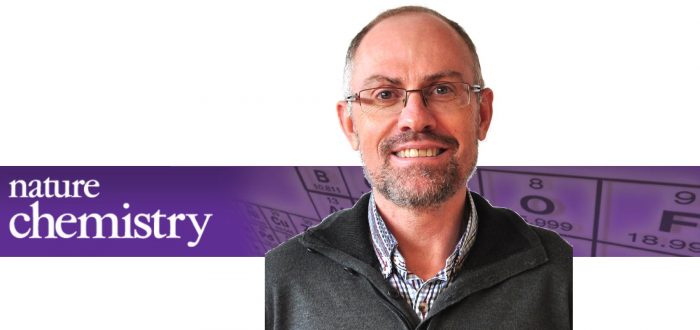
Since the formulation of the Hückel’s rule, a variety of rules have been proposed to determine if a molecule is aromatic. These allow chemists to better understand molecules and their behavior, as well as identify the formation or elimination of (anti)aromatic species in a reaction, which helps understand and predict possible outcomes. In this comment