
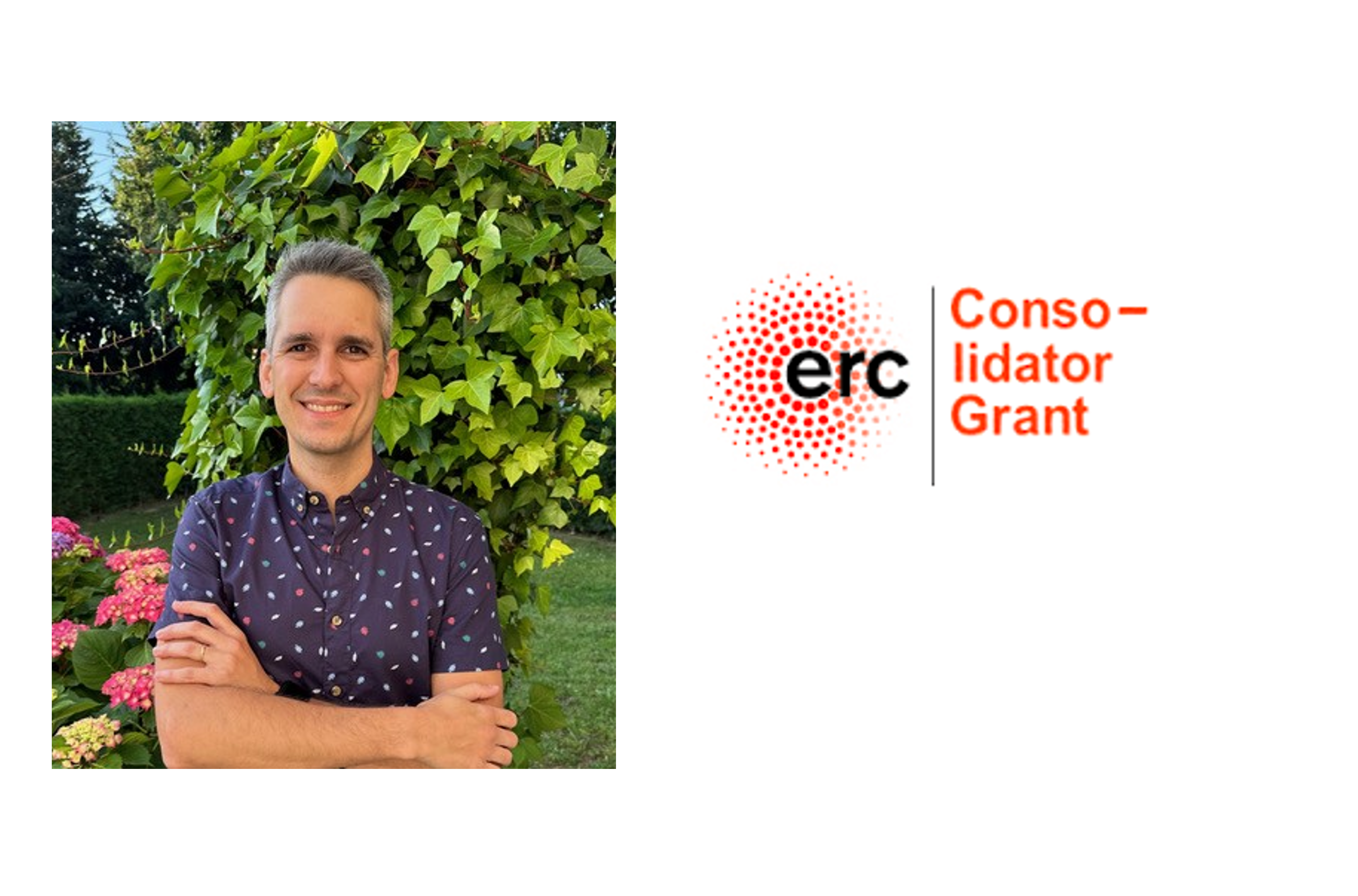
A research project led by Marc Garcia-Borràs, Ramón y Cajal researcher at the Institute of Computational Chemistry and Catalysis (IQCC) of the University of Girona (UdG), has been funded with 2 million euros within the Consolidator Grant call of European Research Council (ERC).
Research projects funded by the ERC have as their main objective to provide the best conditions and environment to foster the creativity of scientists. Scientific excellence is the only evaluation criterion. The Consolidator Grant projects by the ERC provide individual support to scientists that demonstrate the innovative nature, ambition and viability of their scientific proposal, to consolidate their own team or independent research program.
Garcia-Borràs’s BioReInt, Controlling Reactive Intermediates in Biocatalysis through Computational Design Tools (ERC-2025-COG-101232334) proposal focuses on developing an integrative computational framework for designing enzymes capable of catalyzing new-to-nature reactions involving highly reactive intermediates. It proposes a transformative approach by combining a holistic understanding of enzymatic catalysis with cutting-edge computational tools inspired by nature’s evolutionary principles. The innovation lies in harnessing enzyme electrostatic preorganization and active site confinement to control and enhance catalysis in complex reactions involving high reactive intermediates. By leveraging a holistic understanding of enzymatic catalysis and introducing targeted sets of mutations, the project aims to create confined, polarized environments that stabilize reactive species and guide them along desired pathways. Integrating mechanistic insights with electrostatic preorganization and advanced AI-tools for protein structure prediction, this approach enables precise identification of protein sequences optimized for modern biocatalysis, including radical and photocatalytic processes. Beyond advancing fundamental understanding, the project will provide accessible AI tools to support researchers in best practices for computational enzyme modeling, driving innovation in green chemistry, pharmaceuticals, and biotechnology.
IIn this ERC-CoG call, a total of 3,121 proposals were submitted, and only 354 were funded, resulting in a success rate of just 11%.
Trajectory: Marc Garcia-Borràs (Sant Feliu de Guíxols, 1988) has recently been awarded the “Marcial Moreno-Mañas 2023” Award by the Catalan Section of the Spanish Royal Chemical Society (RSEQ); the “Early Career Researcher RSEQ-Lilly 2024” Award; the ACS OpenEye/Cadence Outstanding Junior Faculty Award – Spring 2025 by the ACS Division of Computers in Chemistry, and the “Emerging Scientific Talent 2025? by the Catalan Society of Chemistry (SCQ). He was also finalist at the European Young Chemistry Awards (EYCA) (EuChemS) Early Career Researcher level (2020) and he obtained the UCLA Department of Chemistry and Biochemistry Postdoctoral Research Award (2018).
BioReInt will be developed within the CompBioCat group at the IQCC, co-led by Marc Garcia-Borràs and Ferran Feixas, which integrates expertise in computational chemistry, multiscale modeling, biocatalysis, and artificial intelligence. The team currently includes PhD students Helena Giramé, Cristina Berga, Aqza Elza John, Hande Abe?, Raúl Lago-Saavedra, and Itzel Muro-Puente, and postdoctoral researcher Daniel Bosch. This research line also builds upon the contributions of former PhD students Jordi Soler Parpal (University of Oxford) and Carla Calvó-Tusell (University of California, San Diego), and on a network of collaborations with leading international experimental groups.
Girona, December 10th 2025
For more information: ges.iqcc@udg.edu