-
Ferran Feixas (1983) obtained his PhD in Chemistry with academic honors at the University of Girona under the supervision of Prof. Miquel Sola?, Prof. Jordi Poater, and Dr. Eduard Matito. In this period, he carried out research stays in France, Czech Republic, Germany, and Poland. Upon graduation, he moved to the University of California, San Diego (USA), for a two-year postdoctoral position with a Beatriu de Pino?s fellowship at the Prof. J. Andrew McCammon group. In 2014, he joined the IQCC with a reintegration Beatriu de Pino?s fellowship and, in 2015, was awarded with the Marie Curie Individual Fellowship (IF-EF, MetAccembly). In 2019, he was awarded a three-year Retos Investigación project (RTI2018-101032-J-I00) for developing and applying novel simulation based techniques with applications in the field of biochemistry and supramolecular chemistry (Accembly). In 2019, thanks to the EU and MICINN contribution (MetAccembly IF-EF and RTI2018), he initiated his independent career as Principal Investigator at the IQCC (UdG). He has co-authored 44 publications in international journals.
-
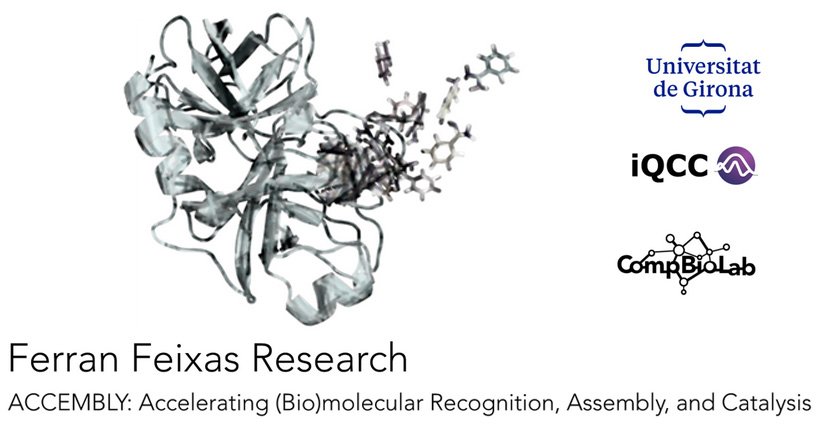
(Bio)molecular recognition and assembly are key concepts in biochemistry, drug design, and supramolecular chemistry. Chemical and life processes are critically dependent on the association and dissociation of (bio)molecules. The pathways that drive recognition, assembly, and dissociation are strongly influenced by the dynamic nature of the interacting partners. A deep understanding of the mechanisms of these relevant processes is of utmost importance. The goal of our group is to develop and apply computational tools to unravel the details of association and dissociation pathways of (bio)molecules to gain insight into the detailed molecular mechanisms of relevant chemical and biomedical processes and, then, harness this information to enhance the discovery and rational design of novel drugs, protein assemblies, supramolecular complexes, and/or (bio)catalysts.We focus on the development and application of enhanced sampling methods for the study of molecular recognition, assembly and catalysis.
– Drug Design: Reconstruction of drug binding and unbinding pathways.
– Enzymes Catalysis / Enzyme Design: molecular basis of enzyme catalysis, allosteric regulation, and enzyme evolution and engineering.
– Supramolecular Chemistry: dynamic reconstruction of molecular recognition in supramolecular complexes (nanohosts and cavitands)
– Photopharmacology: deciphering the molecular basis of allosteric photoswitches in G-Protein Coupled Receptors. -
-
-
-
Feixas, Ferran
ACCEMBLY: Accelerating (Bio)molecular Recognition, Assembly, and Catalysis
Contact info:
Dr. Ferran Feixas ferran.feixas@udg.edu Tel. (+34) 650 28 71 48