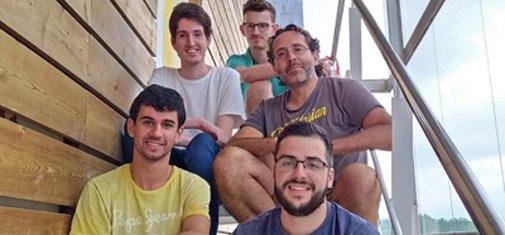
-
Pedro Salvador Sedano (Girona, 1975) carried out his PhD studies in the Department of Chemistry of the UdG under the supervision of Prof. Miquel Duran. His thesis (2001) focused on development and implementation of basis set superposition error correction methods. He has accumulated ca. 3 years of international research experience, being visiting scholar at the City University of New York (Prof. Dannenberg) and the Chemical Research Center of Budapest (Prof. Mayer) among other centers.
Since October 2006 he is an Associate Professor of the Department of Chemistry and a member of the Institute of Computational Chemistry and Catalysis of the UdG. He has been the director of the Master’s in Advanced catalysis and Molecular Modelling from 2013-2019. -
Pedro currently leads a research team at IQCC mainly working on the development and implementation of new tools for wavefunction analysis, with the aim of connecting classical chemical concepts with modern ab initio methods.
Back in 2001 we published a decomposition method of the Hartree-Fock energy (HF) in mono and diatomic contributions in the framework of the Quantum theory of Atoms in Molecules (QTAIM), later known as Interacting Quantum Atoms. The difficulty of the associated numerical integrations motivated the exploration of other alternative definitions for the atom in the molecule based on so-called fuzzy atoms. In 2004 we showed how the classical formulation of bond order or overlap populations could be obtained in a general way in the general framework of the fuzzy atoms. In later works this methodology extended to the decomposition of both HF (2005) and Kohn-Sham DFT (2007) molecular energies.
 During the last years we have shown how to obtain other local physical magnitudes of interest through analysis of the wavefunction, such as local hardness (2007-08) or local spin (2012-14), the latter being used as a quantification of polyradical character (2014).
The implementation of Mayer’s effective atomic orbitals for a general wavefunction (2009, 2013) has allowed us to address the recurrent problem of obtaining oxidation states (2015, 2018) from first principles. We have thus developed the so-called effective oxidation states (EOS) analysis.
We have also proposed new atomic definitions less arbitrary in the fuzzy atoms framework (2013) as well as a significant number of applications, most recent ones involving transition metal systems with intricate bonding situations. Some more recent works have dealt with the application of these analysis techniques for the development of new correlation indicators (2014, 2016) oriented to the design of new DFT and DMFT functionals. We are also currently joining forces with the group of Josep M. Luis focusing on the design and implementation of novel energy-based origin-independent decomposition of linear and nonlinear optical propertiesAll the new methodology that we’ve developed during the last 15 years is implemented in our own code, APOST-3D, which we have made available to the scientific community.
 -
Principal Investigator

Pedro Salvador
Professor Agregat

Staff and Postdocs

Leila Pujal
Postdoc
PhD and MACMoM students

Enric Sabater
PhD Student (FI-SDUR)
Supervisor
- P. Salvador, D. Andrada
Joan Grèbol
PhD Student (FPI)
Supervisor
- P. Salvador, E. Matito (DIPC)
-
Collaboration agreement
Project: Donostia International Physics Center (DIPC)
Researcher: P. Salvador and Josep M. Luis
Reference:
Funding: 118.500 €
Period: 01/01/2022 – 31/12/2026MICIU Proyectos I+D
Project: Estructura electrónica, propiedades y reactividad de moléculas bajo campos eléctricos
Researcher: Dr. Josep Maria Luis and Dr. Pedro Salvador
Reference: PID2022-140666NB-C22
Funding: 131.250 €
Period: 01/09/2023 – 28/02/2027Project: Understanding transition metal-nitrosyl bonding by high-level electronic structure methods
Researcher: Pedro Salvador
Reference: QSB-2020-3-0003
Funding: 216000
Period: 01/03/2025 – 30/06/2025Project: Descomposición en el espacio real de propiedades ópticas no lineales para el diseño racional de materiales optoelectrónicos
Researcher: Dr. Josep María Luis and Dr. Pedro Salvador
Reference: PGC2018-098212-B-C22
Funding: 64.130 €
Period: 01/01/2019 – 30/09/2022Collaboration with Pedro Salvador
- Diego M. Andrada – University of Saarland (Germany)
- Eduard Matito – Donostia International Physics Center (DIPC) (Spain)
IQCC Science Slam 2026, September 29th 12:30h
Since 2015 the IQCC is organizing a Science Slam. On Tuesday September 29th the IQCC organizes the XI edition IQCC Science...Leila Pujal, new Postdoctoral Researcher at IQCC
Dr. Leila Pujal received her PhD from Queen’s University in Canada under the supervision of Dr. Farnaz Heidar-Zadeh Leila Pujal,...IQCC open doors 2026
A few times a year, the IQCC opens its doors and gives the opportunity to high-school students to IQCC open...IQCC Science Slam 2025, October 8th 12:30h
Since 2015 the IQCC is organizing a Science Slam. On Wednesday October 8th the IQCC organizes the X edition to IQCC Science...
Salvador, Pedro
Chemical concepts from wavefunction analysis
Contact info:
Dr. Pedro Salvador pedro.salvador@udg.edu Tel. (+34) 972 41 83 58